About Greenland
Greenland is an autonomous country within the Kingdom of Denmark, situated between the Arctic and Atlantic Oceans to the east of the Canadian Arctic Archipelago. Geographically it forms part of the North American continent, although its political and cultural ties have long connected it with Europe. The country takes its name from its largest island, also called Greenland, which accounts for almost all of its land area.
Human settlement in Greenland stretches back to around 2500 BC, with various indigenous cultures arriving in successive waves. Norse settlers established colonies in AD 986, remaining for several centuries before disappearing sometime in the fifteenth century. Contact between Scandinavia and Greenland was renewed in the early eighteenth century, and Danish rule was gradually established. In 1979 Denmark granted home rule, a development that marked the beginning of a modern partnership known in Danish as Rigsfællesskabet, or the Commonwealth of the Realm. A further transfer of powers followed after a referendum in 2008, leaving the Danish government responsible only for foreign affairs, security and financial policy, along with an annual subsidy to support the Greenlandic economy.
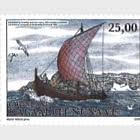
By area, Greenland is the largest island in the world that is not a continent. With a small population spread across vast distances, it is also one of the least densely populated places on earth. The origin of its name is linked to the Icelandic sagas, which recount how Erik the Red, exiled from Iceland, sailed west in search of new land. After settling there, he is said to have chosen the name Greenland in the hope that it would encourage others to follow. The southern part of the island, which is free of ice in summer, does indeed turn green during the warmer months. Greenland’s history, culture and dramatic landscapes are reflected in many aspects of its modern identity.
To view a full list of Greenland stamp products, click here