Faroese Postal Service 50 Years
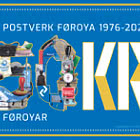
| Miniature Sheet |
| Miniature Sheet CTO |
| First Day Cover |
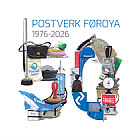
| Special Folder |
On 1 April 1976, responsibility for postal services in the Faroe Islands was transferred to the Faroese authorities. Prior to this, the Faroese postal service had been part of the Danish system, with the Danish Post responsible for all mail to and from the islands. They also handled mail delivery between villages and islands within the Faroes.
One year before the transfer, on 30 January 1975, the Danish Post issued a set of Faroese stamps. However, these were cancelled with Danish postmarks. When the Faroese authorities took over, the occasion was celebrated by issuing new Faroese stamps, this time cancelled with Faroese postmarks. The public had the opportunity to purchase envelopes bearing these stamps, marked with what was called the “first day cancellation” (1 April 1976). Many people took the chance to collect envelopes with this historic first-day cancellation.
It has now been 50 years, a period marked by profound changes in the Faroe Islands, both in infrastructure connecting villages and islands, and in communication between people. In many small villages and on the minor islands, telephone connections were then only semi-automatic. Each household had a telephone with its own number, but to make a call one had to first contact the local exchange and request the desired number. The operator would then place the call and connect the two parties.
This was the nature of telecommunications in many parts of the Faroes when the postal service was taken over. Daily life was not the continuous flow of news and communication we experience today. Telephone conversations were limited, and news was received via radio and newspapers. Consequently, many households subscribed to at least one newspaper, if not several.
In addition to newspapers, weekly magazines were widely read. Most were Danish, such as Familie Journal, Billed-Bladet and Hjemmet. These were not strictly news publications but contained short reports on international events, often accompanied by plentiful illustrations. All of this was delivered by post, bringing both Faroese and international news directly into people’s homes.
Regularly, price lists also arrived by post. Examples include “Daells Varehus” and “Cykelfabrikken Sport” from Denmark, and occasionally German catalogues such as “Quelle”. Customers could order goods by completing an order form provided with the catalogue. Each product had a reference number, which was noted on the form, along with the purchaser’s name and address. The completed form was then placed in a return envelope, also supplied with the catalogue. Postage was free for the customer, as the recipient paid the cost.
In historical research, personal correspondence often provides valuable insight. Letters reveal people’s thoughts and ideas, as well as everyday routines and circumstances that were normal at the time but may have changed over the years. Modern technology—mobile phones, the internet, and long-distance communication—has largely displaced letters. People now have easy access to phones and the internet, and letters no longer play the central role in communication. Greetings and good wishes travel electronically via platforms such as Facebook or Messenger, and letters have gradually yielded to technology.
Occasionally, however, a postcard still arrives through the letterbox, serving as a messenger from the past—a reminder of how communication once took place before long-distance technology became ubiquitous.
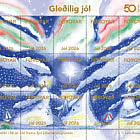
The period leading up to Christmas was particularly special, as large amounts of post arrived. In addition to parcels from various places, distinctive Christmas cards brought warmth into homes during the muted winter light, while snow lay like white ribbons over the hills and the surf crashed against the cliffs. The cards were often beautifully illustrated and plentiful. Nearly every day in the weeks before Christmas, cards arrived bearing greetings from family, friends, and acquaintances. During these days, it almost felt as though the post itself brought a sense of cosy tradition and fond memories into people’s homes. For many, sending and receiving Christmas cards was an essential part of the holiday preparations. Despite the many tasks to complete before Christmas, people still found time to send greetings that travelled across islands and villages by post.
Such was life when the Faroese postal service was established. Gradually, society has changed, and many of the practices once taken for granted are no longer common. Travelling from one place to another could once take a full day or more, but the construction of roads, tunnels, and undersea tunnels has significantly reduced travel times. Technological development has also transformed communication. Electronic communication between people now proceeds at lightning speed. What once took days can now be resolved in an instant. A message sent from Sumba, the southernmost village in the Faroes, to Hattarvík, the northernmost, now takes only seconds instead of days. The price lists have largely disappeared, replaced by online shopping. Most shops now have websites. All these changes must be addressed by the postal service. Physical items, however, still require physical delivery, and Posta is ready with staff and vehicles to transport goods wherever they are needed.
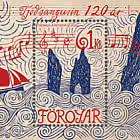
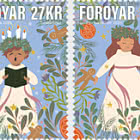
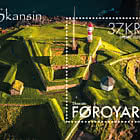
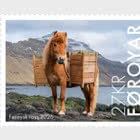
Issuing stamps has always been a traditional part of the Faroese postal service. The first Faroese stamps were cancelled on 1 April 1976. Over the years, various artists have contributed designs. The themes have varied, often reflecting elements of Faroese society, such as ships, birds, and landscapes. Some issues have been linked to national holidays and significant events, while many have showcased Faroese culture and history. Since the first Faroese stamp issue 50 years ago, more than 1,000 stamps have been released.
Óli á Geilini