Art by Skalagard
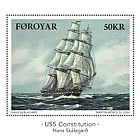
| Miniature Sheet |
| Miniature Sheet CTO |

| First Day Cover |
| Collectibles |
| Special Folder |
| Maxi Cards |
| Postcard |
The Sailor Who Painted History: Hans Skálagarð’s Journey
The man who painted the Constitution, now reproduced on a postage stamp, was Hans Skálagarð. Born at Skálagarður in the village of Skúvoy on February 7, 1924, he was the eldest son of a farming family and was expected to inherit the farm. Instead, he chose a different path the sea and, eventually, art. In the United States he would become known as a master of maritime painting.
Skúvoy, a small and remote island in the North Atlantic, has shaped its inhabitants for centuries. The harsh climate and isolation foster resilience and independence. From an early age Hans felt drawn to the shoreline rather than the routines of farm life. The village had about 130 inhabitants, and children were deeply involved in everyday life. When not at school, they sailed small homemade boats near Skálagarður. Around the shore, rocks and landmarks were named after distant fishing grounds in the Faroe Islands, Iceland, and Greenland. Yet Hans dreamed of going even farther. America had already captured his imagination.
His mother later recalled that he stood apart from other children because of his dedication to drawing and painting an unusual interest in such surroundings.
Early Years at Sea
At sixteen Hans went to sea for the first time, fishing aboard the sloop W.G. Marshall off Iceland. The voyage, made under sail, proved demanding and taught him more than he had expected. Initially he lacked the documents needed to travel farther abroad, but in 1942 he returned to Iceland aboard Grundick with other Faroese men working on the construction of the airfield in Reykjavík.
When the others returned home that autumn, Hans stayed behind. He signed on with the Norwegian ship Tordenskjold, trading around Iceland. His ambition remained unchanged: he wanted to reach America.
That opportunity came in December 1942 when he joined El Coston, a ship transporting supplies for the U.S. Army between Iceland and the United States. On December 16 he stepped ashore in Boston for the first time a turning point in his life. He would never again live permanently in the Faroe Islands.
War at Sea
During the Second World War Hans served aboard several Liberty ships sailing in convoys across the Atlantic. They carried equipment and weapons to Europe and northward to Murmansk and Arkhangelsk. The voyages were dangerous, as German submarines and aircraft frequently attacked the convoys.
In Christmas 1943 Hans was hospitalized with a broken leg after helping save his ship during a violent storm off the American East Coast. When the steering chain broke, leaving the vessel drifting helplessly, he managed in heavy seas to repair the chain and restore control of the ship.
The incident earned him great trust among the crew. He was eventually promoted to boatswain and later served as mate.
He also survived a torpedo attack in the Indian Ocean. The forward section of his ship sank after the explosion. Stationed at the stern, he managed to reach a lifeboat and later a raft. Only three men remained alive when a British warship rescued them and brought them to Durban, South Africa. After recovering, he returned to sea.
Reflecting years later, he remarked: “I could do that because I was so young then.”
Twenty-Eight Years at Sea
After the war Hans continued sailing. Although he visited ports around the world, he rarely spent much time ashore. Instead, he devoted every spare moment on board to drawing and painting ships. Over time he developed exceptional skill in depicting hulls, rigging, sails, sea, and sky, capturing both technical detail and the balance between wind, water, and human labor.
Despite his life at sea, he pursued artistic training. He attended the Royal Academy of Art in Copenhagen for several weeks and later studied in New York under the American marine painter Anton Otto Fisher.
In New York he met Mignon Hack, who organized his first exhibition there in 1954. Born in Oregon and raised in California, she would become an essential partner in his life and career. When Hans came ashore in San Francisco between voyages in 1955, they decided to marry immediately rather than wait until the next day April Fool’s Day.
Hans soon became an American citizen but continued sailing from West Coast ports. Sometimes the intervals between visits home were so long that his daughter Karen scarcely recognized him.
The Gallery in Carmel
In 1965 Mignon discovered a vacant gallery space in Carmel-by-the-Sea and decided to open an art gallery there. At first it displayed works by several artists, but visitors soon showed particular interest in Hans’s maritime paintings.
In 1968 Hans finally came ashore permanently after twenty-eight years at sea and service aboard fifty different American ships. Together he and Mignon devoted themselves fully to his art. Their gallery, Skálagarð’s Square-Rigger Art Gallery, reflected his fascination with historic sailing vessels.
Hans worked meticulously, often studying ship plans to ensure accuracy while also portraying the sailors and daily activity aboard ship. Few marine painters had observed the interaction of wind, waves, and weather as closely as he had through decades of experience at sea.
Recognition and Historical Subjects
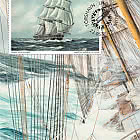
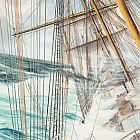
Hans Skálagarð gradually became recognized as one of the leading marine painters in the United States. His works depicted historic vessels from the American War of Independence and the War of 1812, including the famous frigate USS Constitution, known as “Old Ironsides.” Built in 1797, the ship gained its nickname during battle in 1812 when cannonballs reportedly bounced off its strong oak hull.
His paintings were acquired by collectors, maritime museums, and institutions including the Pentagon. One version of his painting of the Constitution is held in the library of the United States House of Representatives.
Later Years
After three decades at sea and another thirty years running their gallery, Hans and Mignon gradually reduced their activities in the late 1990s and moved to Petaluma, north of San Francisco. Although far from the ocean, Hans continued painting almost daily.
Over the years he returned several times to the Faroe Islands. His first visit back came in 1973, thirty-one years after he had left. Later visits included exhibitions and commemorative events. He also painted Faroese vessels, many of which are now displayed in Faroese institutions.
Life’s End
In 2013 Hans was honored as a member of the Scandinavian Hall of Fame in California. Mignon died in 2015 at the age of ninety-one. Hans continued painting as long as his eyesight allowed.
He died on March 3, 2017, in Petaluma at the age of ninety-three. Honoring his final wish, his daughter Karen scattered his ashes over the Pacific Ocean.
Hans Skálagarð sailor, war veteran, and marine painter from Skúvoy left behind a legacy shaped by a lifetime spent between sea and canvas. His works remain a testament to the ships, storms, and oceans that defined his life.
Magni Arge