Faroese Horse
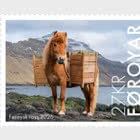
| Set |
| Set CTO |
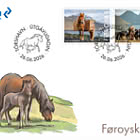
| First Day Cover |
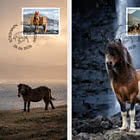
| Maxi Cards |
| Postcard |

| Full sheets |

| Full sheets |
The Faroese Horse – A Story of Survival
In the 1960s, the Faroese horse came close to disappearing forever only five horses remained. Today, it is a story of survival that is still being written.
The Faroese horse is an indigenous Faroese domestic animal that arrived in the Faroe Islands with the first settlers. It has adapted to the Faroese landscape and traditional agricultural work, and has consequently developed into a small, sturdy horse with a calm and gentle temperament. The Faroese horse can be regarded as one of our oldest and purest cultural treasures, and it has undoubtedly played a vital role in sustaining life in Faroese society. For several hundred years before modern tools and equipment could be imported, the horse provided farmers with both a means of transport and a working animal for tilling the land. Genetic analyses confirm that it constitutes a distinct breed, though one closely related to the Icelandic and Shetland horses.
As agricultural implements grew larger and heavier, there was an increasing demand for bigger horses to pull them. Foreign horses, primarily Norwegian and Icelandic, were therefore imported and crossbred with the Faroese stock. At the same time, many Faroese horses were sold to Britain to work in the coal mines. It is estimated that by the early 1800s there were approximately 800 horses in the Faroe Islands, but the crossbreeding and exportation of horses led to the pure Faroese horse passing through a catastrophically narrow genetic bottleneck. By the 1960s, only five breeding horses remained alive, all of them descended from the same four animals. Those four horses are today the ancestors of the entire Faroese horse population.
The Faroese Horse Association (FFR) was founded in 1978 with the aim of preserving the original Faroese horse. At that time, only 13 purebred Faroese horses existed. Through years of dedicated work by passionate enthusiasts, the population has been kept alive and today numbers around 90 horses. The FFR's work is driven largely by volunteers. According to the Food and Agriculture Organization of the United Nations, the Faroese horse is critically endangered. The population would need more than 300 breeding mares to be considered merely endangered.
The FFR's work includes organising the breeding programme, carrying out genetic studies, registering horses in the studbook system Føroya Fongur, and promoting the breed.
The bottleneck has resulted in very low genetic diversity within the population, and the breeding programme must therefore be carefully managed. The FFR collaborates with institutions such as NordGen and the Swedish University of Agricultural Sciences to organise the breeding. Particular emphasis is placed on preserving the remaining genetic diversity while ensuring that all four founding horses are equally represented in the population.
In recent years, the FFR has been working to establish a gene bank containing semen from all Faroese stallions. This will safeguard the genetic heritage of the Faroese horse for future generations and forms an important part of the conservation effort. In this project, the FFR has collaborated with the British company Stallion AI Services, which has specialist expertise in equine reproduction and insemination. In the summer of 2025, this was completed and it is believed to be the first time that semen from an entire animal population has been frozen and preserved.
Efforts have also been made to develop the breeding of Faroese horses abroad. As it is not yet possible to export Faroese horses due to a lack of legislation in this area, the FFR worked with the Danish Højgård Equine Hospital in 2024 to develop a project that would bring Faroese horses to Denmark through embryo transfer technology. Fertilised eggs were retrieved from Faroese mares and implanted into Icelandic mares, which served as surrogate mothers. The Icelandic mares, carrying Faroese foals, were then transported to Denmark to give birth. The result was that three Faroese foals were born in Denmark for the first time in more than 100 years.
The Faroese horse, which for many years has stood on the edge of the abyss, is now slowly stepping back from the brink. Through tremendous voluntary commitment, new technology and growing interest in conservation, the breed is gradually reclaiming its place as a living part of Faroese cultural and agricultural heritage.
The Faroese Horse Association
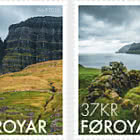
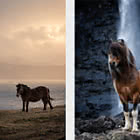
The stamps illustrate Skessa which is one of approximately 35 Faroese mares of breeding age. She is used as a broodmare but also as a riding horse, and brings great joy to her owners, young and old alike. The 37-KR-stamp picture the stallions Munin, Mergur, Óðin and Askur on their summer pasture at Heltnin. They are used in the breeding programme to increase the Faroese horse population. When not with the mares, they enjoy one another's company on the wide pastures.