SEPAC - Skansin
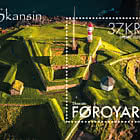
| Miniature Sheet |
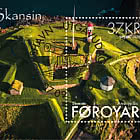
| Miniature Sheet CTO |

| First Day Cover |
The fort of Tórshavn
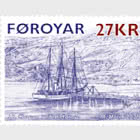
In 1580, Magnus Heinason built the fort known as Skansin in Tórshavn after his trading enterprise had been plundered the previous year. It is believed that his fort was built on roughly the same site at Stangarnes where the inner fort stands today.
In 1629, a brutal raid took place in Hvalba, where pirates killed and abducted several people. To prevent similar attacks in the future, the King ordered the Faroese to build a new fort on Tinganes. Later, the Reynafort was constructed further inland on the peninsula to protect trade from attacks coming from the landward side. For a period, Tórshavn was therefore defended by three forts.
When the King introduced absolute monarchy in 1660, Christoffer Gabel became one of the most powerful officials in the Danish realm. Gabel held the Faroe Islands as a fiefdom and wanted the forts in Tórshavn to be expanded. Maintaining three forts was a considerable burden on the town’s inhabitants, who protested against the harsh demands placed upon them. It was in this context that Lucas Debes, the parish priest of Tórshavn, travelled to Denmark to meet the King. While he was away, the trading buildings on Tinganes were destroyed by fire on 30 January 1673. It was later discovered that 150 pounds of gunpowder had been stored in the merchant’s loft and had somehow been ignited under suspicious circumstances.
Danish foreign policy had a significant influence on the history of the forts. After the Great Northern War ended in 1721, Denmark entered a long period of neutrality. As a result, there was less need to maintain the fortifications. The Reynafort was soon abandoned, and by the middle of the eighteenth century the fort on Tinganes had also been dismantled. Skansapakkhús was subsequently built on its foundations and today houses the Office of the Prime Minister of the Faroe Islands.
The neutrality of the Danish kingdom created favourable conditions for Danish merchants. Among the most successful was Niels Ryberg, who conducted transit trade through the Faroe Islands. Goods arrived in Tórshavn from America and other countries and were then smuggled onwards to Britain by British vessels. When the American colonies rebelled against Britain, Ryberg feared in 1778 that war might break out between Britain and France. He therefore petitioned the authorities either to strengthen the fortifications in Tórshavn or to guarantee compensation should his trade be attacked.
As a result, the Danish Treasury sent Commandant Born to the Faroe Islands in 1782 to construct a new fort. This is the fort that can still be visited in Tórshavn today. It was equipped with at least twenty cannons, yet these proved unable to prevent the British warship Clio from capturing and destroying Skansin on 16 May 1808.
Although Skansin was of limited military value after the British attack, 32 men were still stationed there. One of the first issues addressed by C. L. Tillisch when he arrived in the Faroe Islands as the new County Governor in 1825 was the situation at Skansin. This led to the establishment of the Rifle Corps at Skansin on 1 May 1828.
In 1830, Tillisch succeeded in persuading the authorities to install four cannons at Skansin, which thirty men from Tórshavn were trained to operate. These are the cannons that still stand on the inner wall overlooking the harbour today. When the cannons arrived, gunpowder was stored at various locations around the town. However, no one wished to see a repeat of the disaster of 1673, and a powder magazine was therefore built at Skansin. It still stands today.
The Rifle Corps remained active until 1865, when it was replaced by a police corps that in many respects resembled its predecessor. The police corps was disbanded in 1901, and since then Skansin has served primarily as a landmark rather than a military installation. Skansin is protected by Faroese law and must be preserved as a historic monument.
Skansin saw one final period of military activity during the Second World War, when the British chose it as their main military station in Tórshavn. Their task was to defend the Faroe Islands against a potential German attack, and the first guns they installed were the two large artillery pieces that still stand at Skansin today.
Today, Skansin is a prominent landmark in Tórshavn and a popular tourist attraction. For many travellers arriving aboard passenger ferry MS Norröna, it is also among the very first sights they encounter as they enter the harbour of Tórshavn.
Erling Isholm