Saint Lucia
| Set |
| Set CTO |
| First Day Cover |
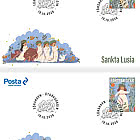
| First Day Cover single stamp |
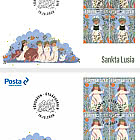
| First Day Cover block of 4 |
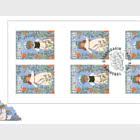
| Collectibles |
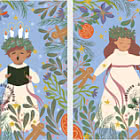
| Maxi Cards |
| Postcard |
| Full sheets |
| Stamp Booklet |
| Stamp Booklet CTO |
The night between December 12th and 13th is the darkest night of the year. It is pitch dark, and no light can be seen. This is the Night of Lucia.
Lucia was a young Christian girl, born in the year 328 in Syracuse, Sicily. It was certainly not safe to be a Christian in the Roman Empire, as the Christian faith was forbidden. Those discovered as Christians were punished with torture and death. Therefore, Christians had to hide in the catacombs beneath Rome.
Lucia helped the people who were hiding in the catacombs. It was dark, so she wore a wreath of candles on her head, allowing her to see while keeping both hands free to help others.
Lucia’s father was a wealthy man who had promised his daughter to a Roman man, but Lucia refused to marry. She wished her entire life to be devoted to God, and therefore she would not enter a marriage. When her intended fiancé learned of this, he became very angry and reported her to the authorities, stating that Lucia confessed to the Christian faith.
It was Emperor Diocletian, who held all power in the Roman Empire at the time. He arrested Lucia and ordered her to be punished. But it was difficult, as it is written that “it was as if a divine power protected her.”
The story says that Lucia gouged out her own eyes so that no man could fall in love with her. Another version tells that her eyes were removed but that she miraculously received new, beautiful eyes. They also tried to burn her at the stake, but the flames would not touch her. Several attempts failed, but eventually she was pierced with a sword and died.
Lucia was canonized as a patron saint, Saint Lucia. There are very few women in the Catholic Church who have been made saints.
Lucia is often depicted in images with a bowl containing two eyes beside a lit lamp. She is the patron saint of the blind and of people with eye diseases. Saint Lucia died on December 13th, 304.
The name Lucia comes from the Latin word lux, meaning light. Lucia’s work in the catacombs, helping the persecuted, has been and still is an example of selfless action. When it is darkest, the light rises again. Saint Lucia, with her wreath of candles on her head, and the girls who follow her carrying candles, symbolize hope that light will overcome darkness.
In the Catholic Church, people ask patron saints for help in times of need. Likewise, people have prayed to Saint Lucia for assistance. One story tells that a famine broke out in Syracuse in 1646. The people prayed to Saint Lucia for help, and on her death day, December 13th, a fully loaded ship of grain arrived, and the people were saved. They cooked porridge, and this custom continues to this day. On December 13th Saint Lucia’s death day it is traditional to cook a special porridge called Cuccia.
The Lucia procession honors Lucia, who gave herself for others, for humanity, and brought light and hope where there was none.
The tradition of Lucia is celebrated differently in various countries. In Italy, it is a church holiday with a service and a procession carrying Lucia’s relics, where the light holds the greatest significance. In Sweden, Lucia wears a wreath of candles on her head and children follow with candles in hand, all dressed in long white robes with red sashes. This tradition is also upheld in Denmark and the Faroe Islands. It is a beautiful tradition symbolizing what humans long for: hope and light, and the anticipation that something good and beautiful will happen.
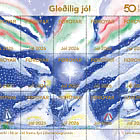
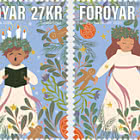
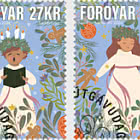
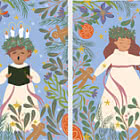
On these beautiful stamps, children hold lit candles in their small hands, and Saint Lucia, with her candle wreath and free hands, is ready to help those in need. Children are always a beginning they are our hope, innocent and pure. They represent the good and beautiful; the child who can change the world and bring light where darkness reigns. It is a reality of everlasting value. We must have hope and light to live as human beings. This is what Saint Lucia, and the children show us on these beautiful stamps.
Children are always the new beginning, and as long as we can light candles for each other, we can live.
Armgarð Arge
The Lucia Song
Now the light is carried forth
proudly on your crown
throughout each house and home
the song resounds
//:Now on Lucia Day
our friends give greeting
Santa Lucia, Santa Lucia://
Here at our festive feast
the song shall ring
gifts to every guest
joyfully you bring.
//:Grant us streams of happiness
through life’s evening hours
Santa Lucia, Santa Lucia://