National Anthem
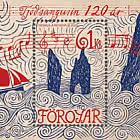
| Miniature Sheet |
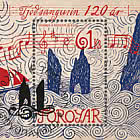
| Miniature Sheet CTO |
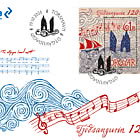
| First Day Cover |
The Faroese National Anthem - 120 Years
In the winter of 1906, Símun av Skarði sat in ”Føgrulíð”, home to the Faroese Folk High School on the island of Borðoy. He was one of the two founders of the school.
A few years earlier, he and Rasmus Rasmussen had helped to establish the school, which was initially housed in a building in Klaksvík. However, the two men had other plans and built a new school on a mountainside on the western side of Borðoy. From there, they enjoyed a fine view of Eysturoy and across Leirvíksfjørður, and the school remained there for several years.
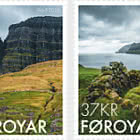
Símun himself came from Skarð, a small village on the neighbouring island of Kunoy. He would therefore undoubtedly have known the surrounding landscape extremely well. It is easy to imagine him gazing across Leirvíksfjørður towards the mountains of Eysturoy and Kalsoy as he sat in “Føgrulíð” writing a poem about his homeland. Perhaps, in his mind’s eye, he also saw his home village of Skarð and the surrounding landscape, picturing the surf raging against the shore in winter and the sea lying silver and calm in summer, like a polished mirror beside the rocks.
From Poem to National Anthem
The poem he was writing was an ode to his homeland, and he gave it the title “Mítt alfagra land” (“My Fairest Land”). A document held by the National Library of the Faroe Islands contains the poem in Símun’s own handwriting. The document is dated 1 February 1906. The poem was first published in the newspaper “Tingakrossur” on 8 January 1908. The newspaper also reported that Petur Alberg had composed a melody for the poem, which had been sung in Tórshavn on Boxing Day. The poem had now become a song, and it soon grew very popular among the Faroese people. Many felt that it was well suited to community singing at special occasions and ceremonies, and before long it came to be regarded as the national anthem of the Faroe Islands.
These verses, which Símun av Skarði wrote down just before Candlemas in 1906, marked the birth of the Faroese national anthem. In three verses, he describes the Faroese landscape and his love for his homeland, as well as his faith in God.
In the first verse, he speaks directly to his homeland: “You, my fairest land, my most precious possession, white around the edges in winter and in summer, when the wind is still…”
Here, he evokes the natural landscape, alluding to the sea roaring in winter, turning the coastal rocks white with spray, while in summer there may be stillness and calm.
He then says: “You take me so tenderly into your embrace...” In these lines, the Faroe Islands are presented as a country, but at the same time as an island community in which each island has its own place. This is why he immediately addresses them in the plural:
“Islands mighty, God bless the name given to you by the men who discovered you. Yes, God bless the Faroe Islands, my land.”
The second verse uses images from nature to describe how light and darkness affect his state of mind. The rays of the sun may shine beautifully on the mountainside on a summer’s day, while winter storms can destroy many a life. Darkness may obscure even the clearest purpose, while light, by contrast, can bring a sense of victory to his soul. He then brings these threads together, describing it as a harmonious interplay that gives him hope and the courage to safeguard the Faroe Islands, his homeland.
In the third verse, he bows his head in prayer to God. He asks to share in the sacred peace and for his soul to bathe in God’s glory. Thus, he can carry with courage the symbol that represents the work that preserves the Faroe Islands, his homeland.
As mentioned above, it was Petur Alberg who composed the melody for the national anthem. He was also known as Petur í Geil and was born in Tórshavn in 1885. He was therefore around 20 years old when Símun wrote the poem. Petur was a violinist and had learned to play under “Baker Hansen”. Baker Hansen was highly musical, and many people learned to play instruments from him. Petur was one of his talented pupils, and in 1907, the year after Símun had written the poem, he composed the melody for it. The song was performed publicly for the first time on Boxing Day 1907. The melody is regarded as Petur Alberg’s best-known composition, although he also composed melodies for other Faroese songs.
Faroese Literature in Growth
The Faroese national anthem was created at a time when Faroese poetry and literature were experiencing significant growth. Símun av Skarði himself was born in 1872, but at that time there was little written poetry in Faroese. Jens Christian Djurhuus, also known as “Sjóvarbóndin” (“the farmer at Sjógv” in Kollafjørður), had written several traditional ballads in Faroese, the best known of which is “Ormurin Langi” (“The Long Serpent”). His son, Jens Hendrik Djurhuus, had also written ballads, as had Poul from Nólsoy and others. Apart from these works, there were relatively few Faroese songs and poems. There were, however, several Faroese writers who wrote in Danish.
Between 1872 and 1906, Faroese literature and poetry developed significantly. This was also the period in which the Faroese written language took shape, while newspapers and magazines began to be published. This created a growing interest in writing poetry in Faroese. Among the poets of the period were Jóannes Patursson, born in 1866; Mikkjal á Ryggi, born in 1878; and the Áarstova brothers from Tórshavn, Janus Djurhuus, born in 1881, and Hans Andrias Djurhuus, born in 1883.
These and other poets began writing about their homeland, its natural landscape and the people who lived on the islands. Mikkjal á Ryggi, for example, is known for his songs about Faroese working life and for writing a large proportion of the hymns in the Faroese hymn book. The Áarstova brothers had very different poetic styles, but both made a major contribution to Faroese poetry and literature. Jóannes Patursson was not only a poet but also a politician who stood at the forefront of the Faroese national movement that emerged towards the end of the 19th century.
Símun av Skarði was himself influenced by these growing national currents in Faroese society. It was a time when there was a strong desire to produce literature and other material in the Faroese language that could be used both in writing and in speech. The composer Petur Alberg was also part of this movement. In addition to music, he was interested in writing and helped to establish the Thorshavn Association for Young Men in 1906. The association published a members’ magazine called “Baldursbrá”. Petur wrote extensively for the magazine and earned recognition among its members for his work. He was therefore accustomed to writing and had grown up in an environment in which the written word played an important role.
His brother, Kristin í Geil, had begun publishing the newspaper “Tingakrossur” several years earlier. The first issue was published on New Year’s Day, 1 January 1901. Kristin í Geil was known for his social criticism and his sharp pen.
It is now 120 years since the Faroese national anthem was written. It is sung at ceremonial gatherings among the Faroese and at international sporting events. The melody by Petur Alberg and the words by Símun av Skarði combine to form a powerful and enduring whole. And when Ólavsøka, the Faroese national festival, is celebrated, the national anthem is sung with great feeling on Vaglið in the heart of Tórshavn.
Over the years, it has become an unmistakable part of Faroese identity and culture. More than a century after they were first written at Føgrulíð on Borðoy on a winter’s day in 1906, these words continue to resonate deeply in the hearts of the Faroese people.
Óli á Geilini